


When matcha is described as stone-ground or machine-ground. The label is telling you how prepared tencha was milled into powder, not giving you a complete verdict on the tea. That distinction matters because the grinding process can influence particle shape, heat management, and how the powder disperses when whisked.
Stone ground vs machine ground matcha comes down to a slower traditional milling approach versus faster, more scalable equipment. Stone milling is closely associated with the texture and ritual of whisked matcha, while machine milling can suit applications where throughput and consistent dispersion matter. Neither term replaces questions about the leaf material, sourcing, harvest, storage, or intended preparation.
For a thoughtful purchase, look beyond a single process label. Ask how the tencha was prepared, whether the milling method is disclosed, and how the matcha is meant to be enjoyed. Understanding what happens between leaf and powder makes those answers easier to evaluate.
Explore Sorate's matcha collection
How Stone Ground vs Machine Ground Matcha Is Made
From tencha leaf to matcha powder
Matcha begins with tencha, the tea leaf material prepared for grinding. After the leaves are harvested and processed, stems and veins are removed so the remaining leaf can be milled into an exceptionally fine powder. This is not the same as steeping loose tea and discarding the leaves. The finished powder is intended to be whisked into water, which makes the texture and behavior of the ground leaf part of the drinking experience.
To understand the process, start with the traditional tencha leaf. Its condition, cultivation, harvest, and preparation all shape the material that reaches the mill. Grinding matters, but it is one stage in a longer production path. The milling label alone cannot establish a matcha's grade or guarantee how every cup will taste.
Traditional stone milling
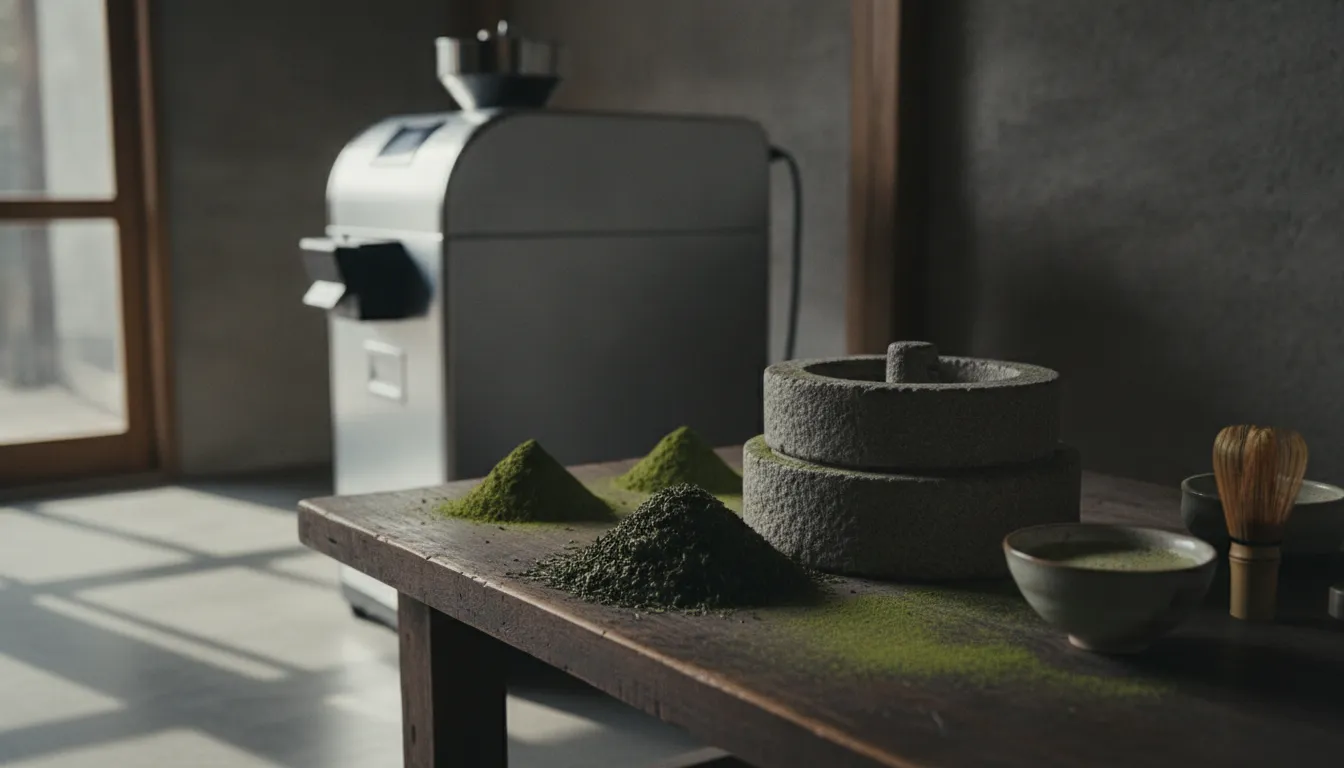
In the traditional method, dried tencha passes gradually between two milling surfaces, commonly referred to as a stone mill or ishiusu. The stones turn slowly and use gentle shear to break the leaf down over time. This slow pace limits throughput, so producing a relatively small amount of powder can require sustained attention and careful handling.
Heat management is an important consideration. Friction is present in any milling process, but a slower operation gives the producer more control over the conditions around the leaf. The goal is to protect the delicate material while creating a fine, consistent powder suitable for whisking. In the context of Japanese tea culture, the stone mill also represents a close connection between craft, tools, and ritual.
Machine and jet milling
Machine milling uses modern equipment to process tencha at a higher rate. The exact machinery can vary, including systems designed to generate fine particles efficiently or to tailor the powder for a particular food and beverage application. Jet milling, for example, uses directed air and impact rather than the slow contact of rotating stones. These approaches can support larger production volumes and more repeatable processing.
Higher throughput does not automatically make machine-ground matcha better or worse. Speed, duration, equipment design, cooling, and the starting leaf all matter. A well-managed machine process can be useful for a specific preparation or production need. While traditional stone milling remains closely associated with the texture and ritual of whisked matcha. When comparing the two, ask what kind of tencha was used, how the mill was managed, and whether the powder was made for your intended preparation. The method is meaningful, but it should be considered alongside the leaf, sourcing, storage, and preparation rather than treated as a complete quality verdict.
What Does Stone Grinding Change in the Powder?
The mill does more than reduce tencha to a smaller size. It also influences the shape, distribution, and handling of the particles that end up in your bowl. Those details can affect how readily the powder disperses in water, how it feels as you whisk, and how much care is needed during production. Still, a stone-ground label is not a complete quality verdict. Leaf material, cultivation, harvest maturity, storage, and preparation all contribute to the finished experience.
Particle size and uniformity affect whisking
Stone milling is a slow process that works the leaf gradually. The resulting powder may have a fine, somewhat irregular particle structure rather than particles that are perfectly round and identical. That distinction matters because particle morphology changes how matcha interacts with water and air. A well-made powder can disperse into a cohesive suspension and develop a fine foam when whisked with the right technique.
Uniformity matters too. If the powder contains a wide range of particle sizes, larger pieces may disperse more slowly while finer particles hydrate sooner. This can contribute to clumping or an uneven mouthfeel. A fine, consistent powder is therefore a useful thing to look for, but appearance alone cannot establish the full quality or provenance of a matcha. Sifting, water temperature, whisk condition, and whisking motion also shape the result.
Machine milling can produce a different particle profile, and modern equipment may be adjusted for a particular beverage application. That does not make every machine-ground powder unsuitable for whisking, just as stone milling does not guarantee a perfect bowl. The practical question is whether the powder's behavior fits the way you intend to prepare it.
Heat management is part of the process
Grinding creates friction. A slower stone-milling process can help manage that friction by limiting the rate at which heat builds during production. High-speed milling may generate more heat if the equipment and cooling process are not carefully controlled. For that reason, responsible production descriptions should address speed, duration, and temperature management rather than relying on the mill name alone.
Heat management may help protect the delicate sensory character of the ground leaf. But it should not be treated as a guarantee of a particular color, aroma, or flavor. Milling technology continues to develop, and some machine systems are designed with cooling or other controls. When comparing stone ground vs machine ground matcha, ask how the tencha was milled, how heat was managed, and how the finished powder is stored. Then consider the powder alongside its source, intended use, and preparation method. The most meaningful evaluation comes from the whole process, not one production label.
When Does Machine Ground Matcha Make Sense?
Machine-ground matcha can be a sensible choice when the job calls for a dependable powder at a larger scale. Or when the matcha will be combined with other ingredients. The important question is not whether a machine was used in isolation. It is whether the milling approach, particle profile, and handling suit the way you plan to use the powder.
Throughput and repeatable particle targets
Stone milling is deliberately slow. That pace is part of the traditional process, but it also limits how much powder can be produced in a given period. Machine milling is designed for higher throughput. Making it more practical when a producer needs to process larger volumes of tencha or maintain a repeatable output for regular production.
Consistency can matter in a food or beverage setting. A producer may specify a particle target and monitor the process so batches behave similarly when mixed into a recipe or beverage. Particle morphology affects how matcha disperses in liquid. Research and industry reporting describe machine milling as capable of producing rounder particles that can disperse effectively in applications such as lattes. That does not make the powder universally preferable, but it can make the format appropriate for a defined use.
Heat management still deserves attention. High-speed grinding can create friction, so responsible production considers the equipment, speed, duration, and cooling strategy rather than treating all machine-milled matcha as identical. Modern milling systems may be designed to control processing temperature. Ask how the producer manages heat if the method is important to your decision.
Food and beverage applications versus tea preparation
Machine-ground matcha often makes the most practical sense in recipes where the powder is whisked into a larger liquid base or incorporated with other ingredients. It can also suit repeat service in cafes, bakeries, and other food or beverage applications that require a steady supply and predictable mixing behavior. In these contexts, throughput and application fit are meaningful production advantages.
That intended use differs from preparing matcha as the central expression of a tea ritual. Traditional whisking places closer attention on how the powder disperses in a bowl, how it feels across the palate, and how the finished foam forms. Stone-ground matcha remains closely associated with that style of preparation because its milling process and particle structure are suited to the ritual. Still, the method alone does not establish a grade, define the leaf material, or guarantee a particular cup.
A thoughtful buyer can ask what the powder was made for, how its particle target is controlled, and whether the producer discloses the tencha source and processing conditions. Faster production is not automatically a defect. Traditional equipment is not a complete quality certificate either. Match the method to the moment. Choose based on preparation, application, and the information available about the product.
Comparing Stone Ground and Machine Ground Matcha
The most useful way to compare these methods is to look past the labels and ask what each process is designed to do. Both begin with tencha, the leaf material that becomes matcha powder. The mill then influences production pace, particle shape, heat management, and how the powder behaves in a bowl or another preparation.
Stone milling takes a slower, more traditional path. Machine milling uses industrial equipment built for efficiency and repeatable output. Neither label, by itself, tells you the complete story of a matcha. Cultivar, harvest maturity, storage, and intended use also matter, so use the comparison as a buying framework rather than a universal ranking.
| Consideration | Stone-ground | Machine-ground |
|---|---|---|
| Method | Tea leaves pass slowly between milling stones, using a gradual shearing action. | Industrial mills, including jet or bead systems, process tea powder at higher speed. |
| Throughput | Slower output suits careful, smaller-batch production. | Higher throughput supports larger volumes and repeatable production. |
| Powder considerations | Particle shape can be more irregular, which may influence how the powder catches water and air during whisking. Heat management remains important. | Particle shape can be more rounded and may disperse readily in liquid. Cooling and process controls can affect the result. |
| Common use context | Often associated with whisked matcha and the texture of a traditional tea ritual. | Often selected for efficient production and applications such as lattes, sweets, or baking. |
| What to ask the seller | What leaf material is used? How is heat managed? How is the powder stored after milling? | What equipment and cooling method are used? Is the powder intended for whisking, drinks, or culinary use? |
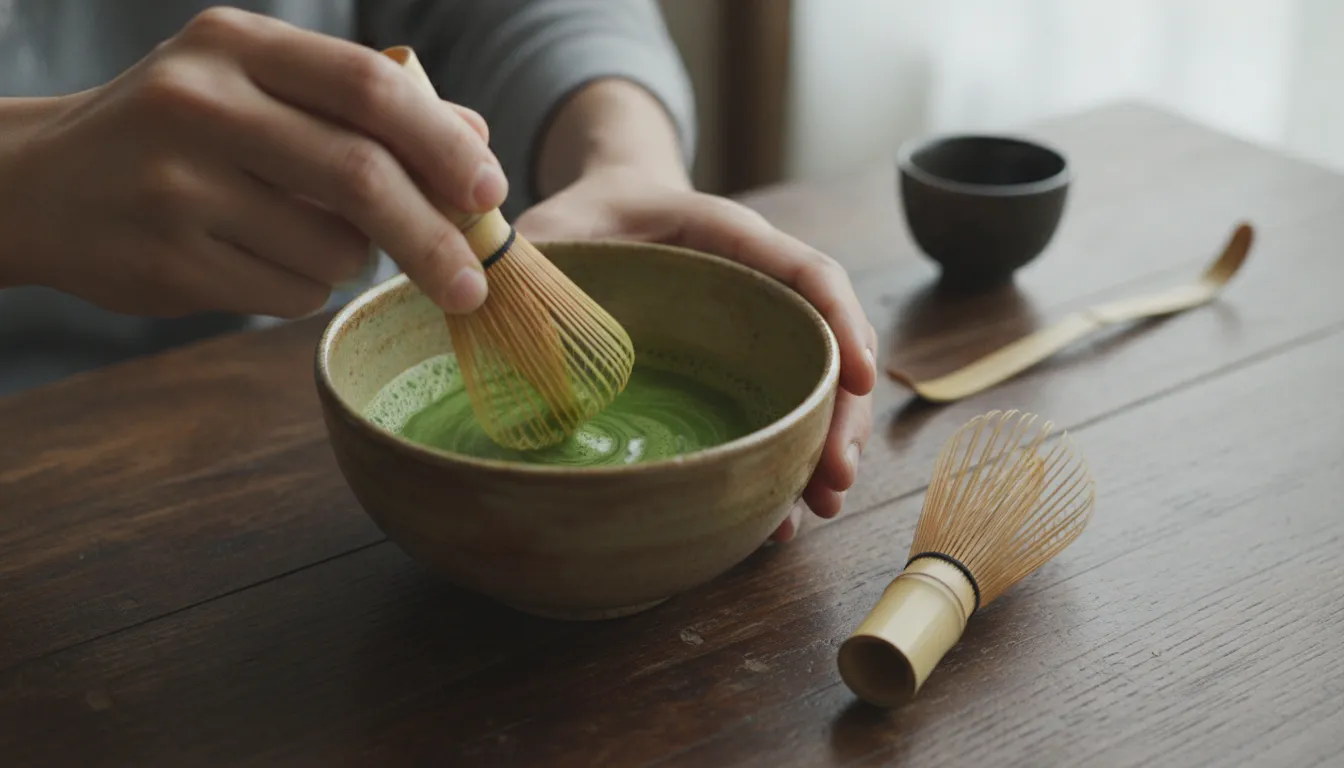
When assessing a tin, connect the method to the experience you want. If whisking texture and the ritual itself are central, ask how the powder was milled and handled. If you are blending matcha into milk or using it in a recipe, dispersion and production consistency may deserve equal attention. A transparent seller should be able to explain the leaf source, milling approach, storage, and intended preparation without reducing quality to one processing term.
It is also worth separating what you can observe from what requires a direct question. A fine, consistent powder is useful information, but color and texture alone cannot confirm the mill used. Packaging language may be brief or may describe the broader production story rather than a particular machine. When the method is not disclosed, evaluate the seller's sourcing details, storage guidance, and preparation recommendations together. That fuller picture gives you a more reliable basis for choosing matcha for your own bowl.
How Should You Choose Matcha After Comparing Milling Methods?
Once you understand the difference between stone milling and machine milling. The most useful next step is to evaluate the complete product rather than relying on one phrase on the label. Milling affects the powder, but the leaf material, production conditions, intended preparation, sourcing, and storage all shape the experience in the bowl. Use this checklist to ask better questions and choose matcha that suits your own tea ritual.
- Start with the leaf material. Ask whether the powder is made from tencha, the leaf material traditionally transformed into matcha. You can learn more about the traditional tencha leaf, including why the starting material matters. A clear description of the leaf gives you more useful information than a vague claim about being finely ground.
- Ask which milling method was used, and whether the method is disclosed. Stone grinding is a traditional, slower approach, while machine or jet milling is designed for greater throughput. If a producer names the method, consider it one meaningful production detail. If the method is not disclosed, do not treat that omission alone as proof of poor quality. Ask instead about the grinding speed, heat management, and the resulting powder.
- Match the powder to your intended preparation. Will you whisk it on its own as usucha, use it in koicha, prepare a latte, or add it to a culinary recipe? Particle size and uniformity affect how powder disperses in water and feels when whisked. Traditional whisking may lead you to prioritize the texture and foam associated with a carefully milled powder. Other preparations may place greater emphasis on consistent dispersion and practical use.
- Investigate sourcing and production context. Look for a specific origin, a transparent producer, and a clear account of how the tea was made. Climate, cultivar, leaf maturity, and grinding process can all influence the final matcha, so no single method tells the entire story. When Japanese provenance and a direct farm relationship matter to you, those details should be part of the decision.
- Plan for proper storage after milling. Fine matcha powder is sensitive to its environment. Keep it sealed, protected from heat, light, moisture, and strong odors, and follow the producer's storage guidance. A carefully made powder still needs thoughtful handling once it reaches your kitchen.
- Keep milling separate from grade. Stone-ground versus machine-ground matcha describes processing. Ceremonial and culinary labels describe a different kind of product distinction, and neither category should be treated as a complete guarantee by itself. For a clearer overview, read how processing differs from matcha grade. Then consult a broader guide to choosing matcha for a wider set of quality questions.
This approach keeps the comparison practical. Milling method can help you understand how matcha was produced. But your best choice comes from weighing that information alongside the leaf, provenance, preparation, and care the powder receives.
Does Milling Method Decide Which Matcha Is Best?
No. Milling method matters, but it cannot answer the entire question by itself. In the stone ground vs machine ground matcha discussion, the more useful conclusion is that each method describes one stage of production. The final experience also depends on the leaf material, how and where it was sourced. The intended preparation, the care taken after milling, and how the matcha is classified.
Stone milling is closely associated with traditional matcha production and a slower pace. That approach can support careful heat management and a powder suited to whisking as part of a tea ritual. Machine milling is designed for efficiency and higher throughput, and its results can vary with the equipment, settings, cooling, and application. The label alone does not tell you everything about the powder in your tin.
Start with the leaf, not only the mill
Matcha begins with tencha, the prepared leaf material that is ground into powder. Its cultivar, growing conditions, harvest maturity, and handling establish the foundation before milling begins. A thoughtful evaluation therefore asks where the tea comes from and what leaf was used, rather than treating a traditional process as a complete quality guarantee.
Grade is another separate consideration. It may describe the intended use or quality category, but it is not interchangeable with milling method. For a clearer distinction, read how processing differs from matcha grade. Keeping these terms separate makes it easier to compare products without relying on a single impressive-sounding label.
Match the powder to the way you drink it
Your preparation also changes what matters most. If you plan to whisk matcha with water and pay close attention to texture, foam, aroma. And the rhythm of the preparation, you may value the characteristics traditionally associated with stone milling. If you use matcha in a latte or a recipe, dispersion, consistency, and practical availability may carry more weight. This is not a verdict that one method is always better. It is a question of fit.
Before buying, ask whether the producer discloses the milling method, what tencha or leaf material is used, where it is sourced, and how the powder should be stored. Look for a fine, consistent powder, then consider the freshness information and preparation guidance provided by the seller. Storage matters after milling because fine powder is sensitive to its environment. When you are ready to compare options, explore Sorate's matcha collection with these questions in mind. And choose the tea that suits your ritual rather than chasing a universal winner.
Browse Sorate's matcha collection
Frequently Asked Questions
What is the difference between stone-ground and machine-ground matcha?
Stone grinding uses a traditional, slower milling approach, while machine or jet milling is designed for higher throughput. The process can affect particle size, powder uniformity, and heat management, but neither method alone defines the matcha's grade or guarantees a particular cup.
How can I tell if my matcha is stone-ground?
Start with the producer's description, since appearance and taste cannot prove the milling method. Ask whether the powder was stone-ground, what leaf material was used, and how the producer manages storage and heat during production.
Is stone-ground matcha worth choosing for every preparation?
That depends on your priorities and how you prepare matcha. If the traditional milling process and its powder characteristics matter to your tea ritual, stone-ground matcha may be a meaningful choice. For other uses, focus on preparation fit, sourcing, grade, and the producer's handling details.
What happens to matcha during machine grinding?
Machine grinding breaks down prepared tea material through a faster mechanical process. It can be tailored to different food and beverage applications, and its higher throughput may suit larger-scale production. Ask the producer which milling system was used and how the process is controlled.
Is milling method the same as matcha grade?
No. Milling method describes how the tea material becomes powder, while grade is a separate way of describing the product's classification and intended use. When comparing matcha, consider both, along with the leaf material, sourcing, preparation, and storage guidance.
Ready to Explore Matcha for Your Ritual?
The right matcha choice starts with clear details about its processing, preparation, and sourcing. Take the next step and explore Sorate's matcha collection to compare your options with care.


