


A Japanese tea set brings the pieces of tea preparation and serving into one thoughtful arrangement. It may include a teapot, cups, tray, and a few useful accessories, but there is no universal checklist. The best set fits the tea you drink, the people you serve, and the space where the ritual happens.
Explore Sorate's tea accessories
A Japanese tea set is a coordinated group of teaware used to prepare, pour, and share Japanese tea. A practical set usually starts with a teapot and cups, then adds a tray, tea caddy, strainer, or discard dish when those pieces support the occasion. Choose by use rather than by a fixed list.
The phrase can describe a compact arrangement for one person, a larger setup for guests, or a gift that introduces someone to Japanese tea. It can also refer to a coordinated collection of vessels sold together. Before buying, check exactly what is included. A set may contain cups without a teapot, a pot without cups, or accessories designed for matcha rather than brewed leaf tea.
What is a Japanese tea set?
A Japanese tea set is a group of vessels and serving pieces that work together around a tea ritual. The core relationship is simple: a vessel holds the leaves and water, cups receive the infusion, and a stable surface makes the movement between brewing and drinking comfortable. Other pieces support storage, carrying, pouring, or cleanup.
The word set does not mean every piece must match. A ceramic kyusu can sit comfortably beside yunomi cups with a different glaze, provided the pieces are balanced and pleasant to use together. A tray can organize the arrangement, while a tea caddy or small dish can stay nearby without becoming part of every place setting.
A museum record from the Smithsonian's National Museum of Asian Art illustrates this variety. Its record describes a kyusu as part of a sencha set with a hot-water ewer, six tea cups, and an original wooden box with lid. View the Smithsonian sencha set record. That documented group is one example, not a rule for every home tea table.
It is also useful to separate a Japanese tea set from a formal tea ceremony arrangement. A home set can support a personal or shared tea ritual without claiming to reproduce chanoyu, the studied Japanese way of tea. Formal practice has its own tools, procedures, schools, and teaching context. This guide focuses on practical teaware for preparing and serving Japanese green tea at home.
Which pieces belong in a Japanese tea set?
The essential pieces in a Japanese tea set are the ones that make your chosen tea easy to prepare and share. For brewed leaf tea, that usually means a teapot and cups. A tray, hot-water vessel, tea caddy, strainer, and discard dish are useful additions when they solve a real serving or storage need.
| Piece | Japanese term or example | What it does | Is it essential? |
|---|---|---|---|
| Teapot | Kyusu or another Japanese teapot | Holds leaves and water, then pours the infusion | Usually yes for brewed leaf tea |
| Tea cups | Yunomi | Receives the tea for sipping and sharing | Yes, choose enough for the people served |
| Tray | Serving tray | Creates a stable surface and helps carry pieces | Useful, but optional |
| Hot-water vessel | Kettle or separate ewer | Heats or holds water for brewing and refills | Needed somewhere in the process, not always part of the set |
| Tea caddy | Tea container | Keeps the tea you plan to serve close at hand | Optional |
| Strainer or infuser | Built-in or removable filter | Helps retain leaves while pouring | Depends on the teapot |
| Discard dish | Small waste or leaf dish | Provides a place for used leaves or drips | Optional, often convenient |
Teapot or kyusu
The teapot is the working center of a brewed-tea set. A kyusu may have a side handle, a rear handle, or no handle at all, depending on its form. Choose one that matches your leaf tea, serving volume, filter design, and comfort in the hand. Capacity matters, but the way the pot pours matters just as much.
If you want to compare kyusu forms, filters, handles, and capacity in depth, read Sorate's Japanese teapot guide. This article keeps the focus on how a pot fits into the wider set rather than repeating a full teapot buying guide.
Yunomi and other tea cups
Yunomi are handleless Japanese tea cups commonly used for everyday brewed tea. They come in different heights, widths, materials, and capacities. Pick a number that suits the people you usually serve, then consider how the cups feel when filled and how they will be stored.
Not every Japanese tea set uses identical cups. A small set of two can suit a quiet shared ritual, while four or six cups may make sense for guests. Saucers are optional. They can provide a landing place for a cup or catch a drip, but they can also take up room on a small table.
For a closer look at yunomi shapes, materials, and tea-specific starting capacities, see Sorate's guide to Japanese tea cups. Keep matcha bowls separate in your thinking: a chawan has a wide interior for whisking and is not required for a pot-and-cup leaf-tea set.
Tray and serving surface
A tray gives the set a clear center. It can help you carry a pot and cups from the kitchen to the table, contain small drips, and make the arrangement feel intentional. It is not mandatory. A clear, stable table can do the same job when a tray would crowd the space.
Choose a tray that fits the pieces you actually use. Leave enough room to lift each item without catching a neighboring cup. A tray that is too small creates more handling than it solves, while one that is too large can make a compact tea ritual feel spread out.
Supporting accessories
A tea caddy keeps the leaves you intend to serve within reach. A strainer helps when the pot does not already retain the leaves effectively. A small discard dish gives used leaves or a removable infuser somewhere to go. A separate ewer can hold hot water for refills, although it is not necessary for every session.
Add these pieces one at a time. If your teapot has a built-in filter, a second infuser may add little. If you drink alone, six cups may become storage rather than service. The strongest set is the one in which every piece earns its place.
How do you choose pieces for the tea you serve?
Choose a Japanese tea set by starting with the tea and the serving pattern. Sencha, gyokuro, genmaicha, and hojicha can all be brewed in a pot-and-cup arrangement, but the preferred volume, filter, and cup feel may differ. Matcha uses a bowl and whisk, so it needs a different preparation setup.
- For sencha: Choose a comfortable pot with a filter suited to the leaf and medium-sized cups for repeated pours.
- For gyokuro: Smaller cups and a smaller pot can suit a concentrated, deliberate serving style. Let the tea's preparation guidance lead the details.
- For genmaicha: A versatile pot and everyday yunomi make a relaxed combination for solo drinking or sharing.
- For hojicha: Choose cups that feel comfortable with a warm, generous pour and a pot that is easy to lift and rinse.
- For matcha: Use a chawan, chasen, and related tools rather than treating a teapot and yunomi as a complete matcha set.
These are starting points, not rules about what is authentic. A pot's filter and actual capacity are more useful than a label alone. If you serve more than one tea, consider whether you want one flexible set or separate pots and cups that stay associated with particular teas. Sorate's Japanese green tea collection can help you explore the teas your set will support.
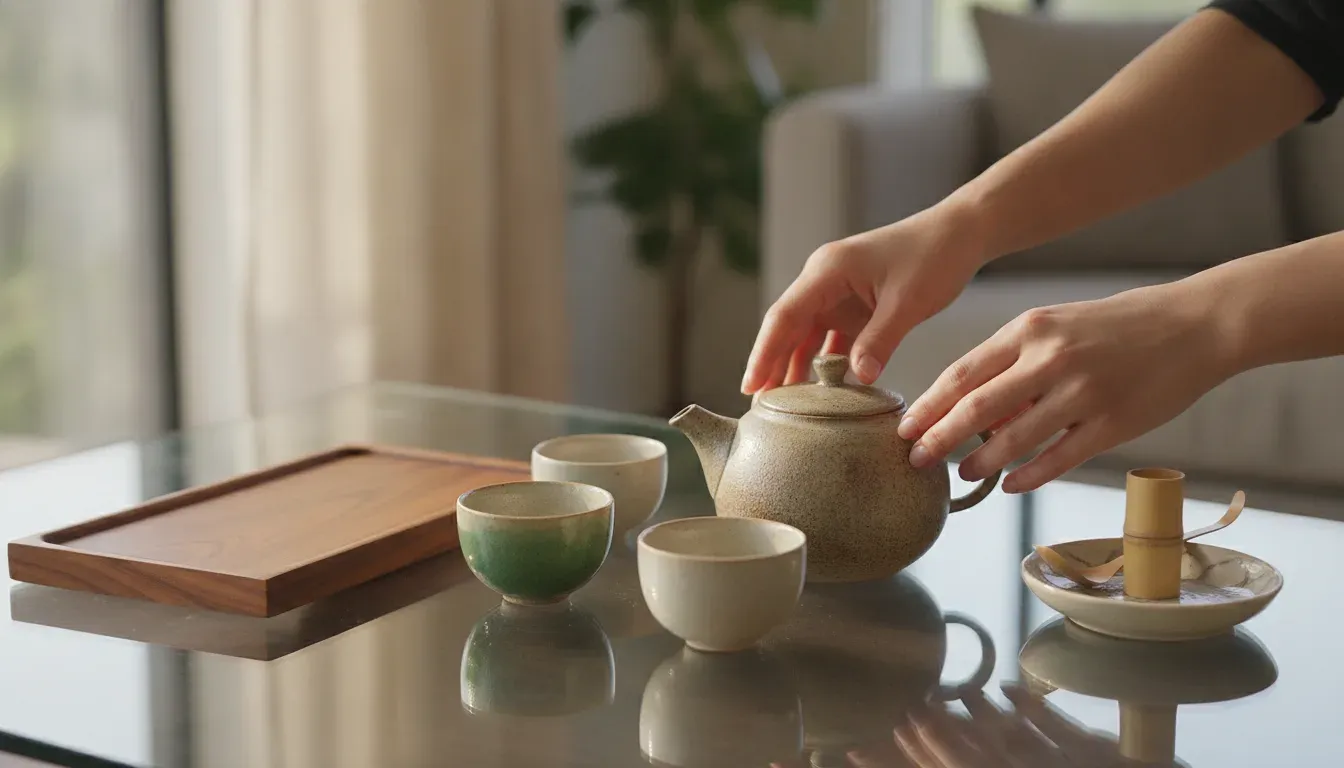
Comfort is part of the choice. Lift the pot empty and imagine it filled. Can you hold the handle securely? Does the lid stay in place as you pour? Can each cup be lifted without brushing another piece? A beautiful group of objects is more useful when the whole movement feels natural.
Which Japanese tea set is right for each occasion?
The right Japanese tea set changes with the occasion. A solo setup should be easy to reach and store. A guest setup needs enough cups and a clear serving path. A gift setup should complement what the recipient already owns rather than assuming that one package contains every piece.
| Occasion | Starting pieces | What to prioritize |
|---|---|---|
| Solo tea | Small teapot, one cup, tea caddy | Comfort, easy cleanup, and compact storage |
| Two people | Teapot, two yunomi, tray or clear surface | Even pouring and a comfortable shared reach |
| Guests | Teapot, cups for the group, tray, discard dish | Safe movement, enough landing space, and refills |
| Gift | One useful piece or a coordinated kit | Recipient's tea habits, space, and existing teaware |
For a quiet solo ritual
A solo set can be wonderfully simple. Use one pot, one yunomi, and a clear place to set them down. Keep tea nearby in a caddy only if it makes the routine easier. A tray can help define the space, but it is not necessary when you brew beside a stable table.
Think about storage before adding pieces. A smaller group that you reach for often is more useful than a large set that remains packed away. Rinse the pot and cup according to the maker's guidance, then let them dry fully before putting them away.
For sharing with guests
When serving guests, count the cups first and leave room for safe handling. Position the pot where you can pour without reaching over someone. Keep extra supplies to the side rather than placing every accessory on the main table. This guide covers the set itself; for a fuller guest-focused serving workflow, see Sorate's tea service set guide.
A guest setup does not have to be formal. The goal is a clear, comfortable path from pot to cup. Matching every piece is optional. Repeating one color, finish, or shape can create visual connection without requiring a complete matching collection.
For a thoughtful gift
Before gifting a Japanese tea set, consider what the recipient already drinks and owns. Someone who brews sencha may value a well-chosen pot or cups, while someone new to Japanese tea may prefer a smaller kit that makes the first steps straightforward. Ask whether the recipient has space for a larger arrangement and whether they prefer practical or decorative pieces.
Read the contents carefully. A gift labeled as a tea set may include tea and accessories but not a teapot, or it may include one cup rather than a group. Sorate's kits and sets collection and gift collection offer starting points, while individual accessories let you build around the recipient's routine.
How do you arrange and use a Japanese tea set?
Arrange a Japanese tea set so the next action is easy. Start with a stable surface, place the pot within comfortable reach, and set cups where each person can lift them without crossing another guest's space. Bring out only the tools needed for this tea and this occasion.
- Clear the surface. Remove unrelated objects and make a safe landing place for the pot, cups, and hot-water vessel.
- Place the pot and cups. Keep the pot where you can pour with control. Set cups in a simple line or arc, with enough space between them to lift and replace each one.
- Add useful accessories. Bring out a tray, caddy, strainer, discard dish, or extra water only when it supports the service. Do not crowd the table with pieces you will not use.
- Prepare the tea. Follow the tea's brewing guidance and use the pot's filter as designed. For a specific water, time, and temperature method, use a tea-focused reference rather than guessing from the set.
- Pour evenly. If serving multiple cups, distribute the infusion across them so the first and last cups are similar. Keep the pot steady and return it to its clear landing place.
- Reset between rounds. Move used leaves, drips, and empty cups when convenient. Keep the next pour simple instead of allowing supplies to take over the table.
This arrangement is practical guidance for a home ritual, not a formal ceremony procedure. It is also adaptable. A solo drinker may keep everything close, while a host may use a side station for extra water and reserve cups. Let the table, tea, and people in front of you determine the final layout.
How can you build a set over time?
You do not need to buy every piece at once. Begin with the item that removes the biggest obstacle in your routine. For one person, that may be a comfortable teapot. For a household that already owns a pot, it may be two or four cups. For a frequent host, a tray or discard dish may make serving noticeably easier.
Choose pieces that can work together without requiring perfect visual matching. A restrained palette, a shared material, or one repeated shape can connect items acquired at different times. Leave enough storage space for the pieces to dry and remain easy to reach.
Care matters more than a long inventory. Follow the maker's directions for ceramic, bamboo, wood, metal, or glass. Avoid assuming that every pot or cup is dishwasher-safe. Rinse promptly when appropriate, dry thoroughly, and store delicate pieces where they will not knock against one another.
Over time, the set becomes a record of how you drink tea. One cup may become the everyday favorite. A tray may come out only when friends visit. A small pot may stay associated with a particular leaf. That gradual, useful relationship is more meaningful than buying a large collection simply because it is sold as a complete set.
Explore Sorate's tea kits and sets for a considered tea ritual
Frequently asked questions
What is usually included in a Japanese tea set?
A Japanese tea set commonly starts with a teapot and tea cups. Depending on the design, it may also include a tray, tea caddy, strainer, hot-water vessel, or discard dish. Check the specific contents because the phrase does not describe one universal checklist.
What are Japanese tea sets called?
There is no single Japanese word that names every home tea set. The individual pieces have names such as kyusu for a teapot and yunomi for a common handleless tea cup. A set for formal chanoyu involves a different vocabulary and a wider group of utensils.
What is the difference between a tea set and a tea service?
A tea set usually describes the physical pieces, such as a pot and cups. A tea service can describe the broader arrangement or act of serving, including a tray, guest seating, refills, and the movement from brewing to drinking. Retailers may use the terms differently, so read the item list and description.
Can you use a Japanese tea set for matcha?
You can use some pieces around a matcha ritual, but a pot-and-yunomi set is not a complete matcha preparation set. Matcha is traditionally whisked in a chawan with a chasen and supported by other tools. Use the pieces designed for the tea you are preparing.
How many cups should a Japanese tea set have?
Choose the number of cups based on the people you usually serve and the space you have. One cup works for a solo routine, two suits a shared ritual, and four or more may help when hosting. Extra cups are useful only when you have room to store and handle them comfortably.
Are Japanese tea sets valuable or collectible?
Some individual pieces may have historical, artistic, or maker significance, but age and appearance alone do not establish value. If you are assessing a collectible, look for reliable provenance and consult a qualified specialist. For everyday use, choose a set for comfort, care, and the tea ritual it supports.
A Japanese tea set does not need to be large, perfectly matched, or reserved for a special occasion. Start with a pot and cups that feel right, then add only the pieces that make brewing and sharing easier. The most useful set is the one that brings Japanese tea naturally into your home.


