


A Japanese tea ceremony can feel intricate from the outside: when should you bow, how should you hold the bowl, and what happens if you miss a cue? Tea ceremony etiquette is not a performance test. It is a way to show care for the host, the other guests, the utensils, and the quiet moment you share. If you arrive prepared, observe closely, and follow the host's guidance, you already understand its most important lesson.
Explore Sorate's ceremonial matcha and begin your own attentive tea ritual.
The Japanese tea ceremony, often called chanoyu or chado, has many schools and levels of formality. A complete formal gathering can include a meal and more than one preparation of tea, while an introductory experience may focus on sweets and a single bowl of matcha. The exact gestures may differ, but attentive participation is always more valuable than trying to imitate a sequence from memory.
Tea ceremony etiquette begins before you arrive
Sorate encourages first-time guests to treat preparation as their first expression of respect. Arrive a little early so the gathering can begin without interruption. Choose clean, modest clothing that allows comfortable sitting, and wear clean socks because shoes are usually removed before entering a traditional tea room. Avoid strong fragrance, which can compete with the aroma of tea and incense. Remove bulky rings, bracelets, and watches that could touch or scratch a tea bowl.
Silence your phone before the gathering. Ask the host whether photography is welcome and, if so, at which moments. A tea room is designed to focus attention, so even a quiet screen can interrupt the atmosphere. If you have allergies, dietary restrictions, mobility needs, or difficulty sitting on the floor, share them in advance. A thoughtful host can guide you more easily before the ceremony begins.
Practices differ among tea schools and hosts. Rather than memorizing every movement, arrive ready to watch, listen, and follow the lead of the host or a more experienced guest. This balance of preparation and openness is the foundation of considerate tea ceremony etiquette.
What should a first-time guest bring and wear?
Sorate recommends simple clothing and very few personal items for a first tea gathering. Traditional kimono is not expected unless the invitation specifically asks for it. Clothing should be comfortable enough for sitting and restrained enough that it does not distract from the utensils, flowers, and seasonal details selected by the host.
- Wear clean socks. Guests commonly remove shoes before stepping onto tatami.
- Choose modest, comfortable clothing. Avoid garments that make sitting or moving carefully difficult.
- Remove hand jewelry. Rings and bracelets can damage a handmade chawan, or tea bowl.
- Avoid perfume and scented products. Matcha, incense, flowers, and tatami each contribute subtle aromas.
- Bring curiosity rather than equipment. The host normally provides what you need. If special items are required, the invitation should say so.
Experienced guests may carry a folding fan, kaishi paper, and a sweet pick, depending on the school and occasion. A beginner should not feel obligated to buy these before attending. Ask the host if you are uncertain. The considerate question is itself more respectful than arriving with an object you do not know how to use.
How should a first-time guest enter the tea room?
Sorate views entering the tea room as a transition from ordinary pace to deliberate attention. The host may lead you directly into a contemporary space, or you may be invited to pause, bow, and appreciate a scroll or flower arrangement before sitting. Follow the sequence offered rather than moving ahead on your own.
- Remove your shoes when directed. Step onto the tatami only in clean socks, and move carefully through the room.
- Pause and bow. A gentle bow acknowledges the host, the gathering, and the space. A beginner does not need to reproduce a formal bow perfectly.
- Observe before sitting. Guests may be invited to appreciate the scroll, seasonal flowers, or utensils chosen for the occasion. Look without touching unless invited.
- Follow the seating order. The principal guest, or shokyaku, usually has a particular place and helps guide the exchange with the host. First-time guests are often seated where they can follow others easily.
- Settle quietly. If seiza, the kneeling position, is uncomfortable, tell the host. Many contemporary gatherings can accommodate another position.
Tatami customs can vary, including how guests cross or avoid the fabric borders. Do not become so focused on the floor that you stop noticing the gathering. Follow the person ahead of you, move without haste, and accept gentle correction with a bow or quiet word of thanks.
The spirit behind each gesture
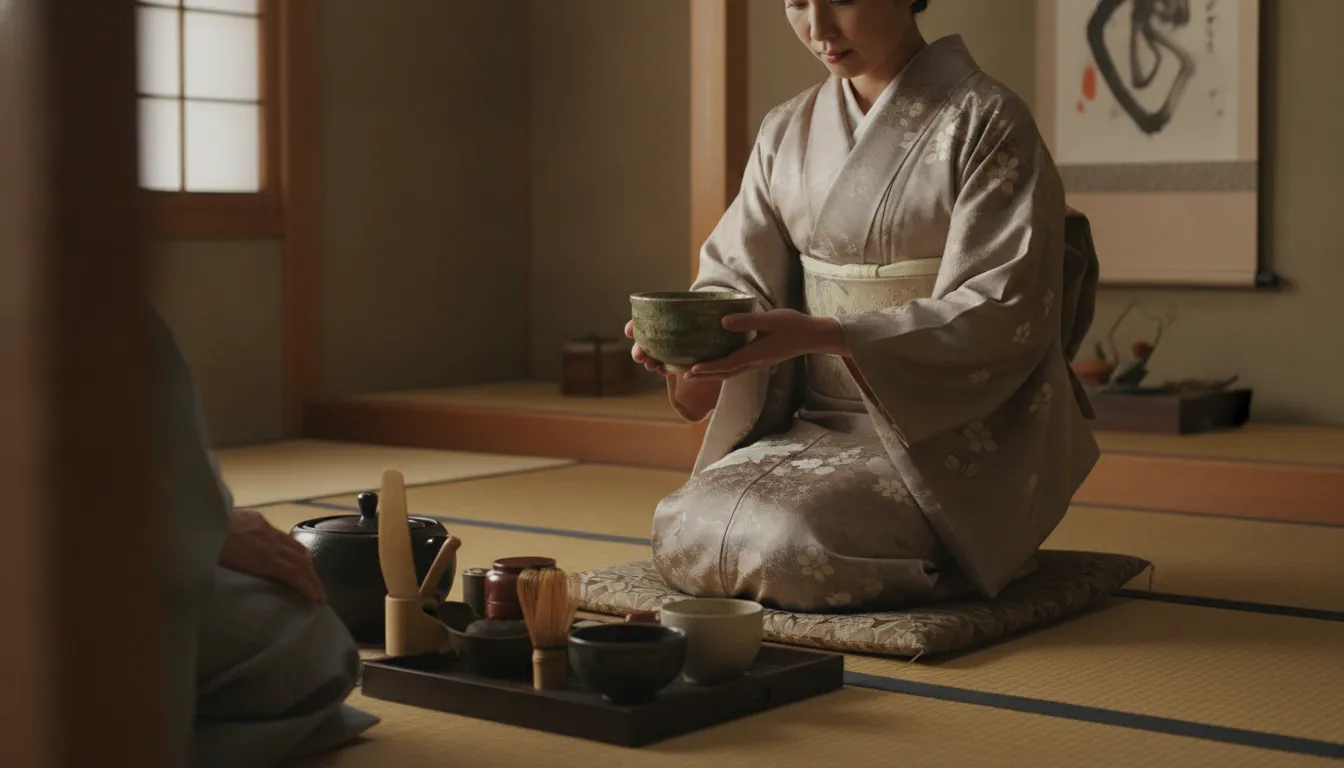
Sorate approaches Japanese tea through four principles often associated with chanoyu: harmony, respect, purity, and tranquility. These ideas become visible through simple actions. The host prepares each utensil with care, guests wait for one another, and everyone gives full attention to a bowl of tea that will never be experienced in exactly the same way again.
Harmony asks participants to notice their relationship with one another and with the setting. Respect appears in a bow, careful handling, and patience. Purity includes the visible cleansing of utensils, but it also suggests setting aside distraction. Tranquility is not forced silence. It is the calm that can emerge when everyone attends to the same small actions.
For a guest, respect means noticing. Observe the seasonal arrangement, the character of the bowl, and the sound of water. Let quiet moments remain quiet. Conversation, when invited, often concerns the tea, the utensils, or details chosen by the host. Etiquette creates a shared rhythm, but sincerity matters more than technical perfection. A calm pause and a quiet question are better than rushing through a gesture you do not understand.
Meet the family-owned Uji farm behind Sorate's Japanese tea.
When and how do guests eat the sweets?
Sorate presents wagashi as part of the sensory progression of tea, not merely a snack beside it. Their sweetness prepares the palate for matcha. Their color, shape, and motif may also reflect the season selected by the host. Wait until the host invites you to eat, then finish the sweet before the tea is served.
If kaishi paper and a small sweet pick are provided, place the sweet on the paper and use the pick rather than your fingers. Moist sweets and dry sweets may be handled differently, so watch the guest beside you or quietly follow the host's cue. If sweets are passed from one guest to another, acknowledge the neighboring guests and take only your portion.
A simple expression of thanks is enough. You do not need to analyze the sweet aloud, but you may notice how its sweetness changes your experience of matcha. That progression is intentional: first the seasonal image, then sweetness, then the tea's fragrance, texture, and gentle bitterness.
How to receive and drink matcha respectfully
Sorate teaches that receiving a bowl is an exchange between host and guest. Procedures vary by school, but the common sequence is easy to understand: acknowledge the offering, handle the bowl carefully, avoid drinking from its most expressive face, and return it with gratitude.
- Receive the bowl with a bow. When the chawan is placed before you, acknowledge the host and, when appropriate, the neighboring guest.
- Lift it with both hands. Place the bowl on your left palm and steady it with your right hand.
- Turn the bowl. The most expressive side is treated as the front. Rotate the bowl as the host demonstrates so you do not drink directly from that face.
- Drink without rushing. Enjoy the matcha in the rhythm shown by the host. Formal conventions vary, so there is no need to force a specific number of sips unless instructed.
- Appreciate the bowl. After drinking, you may be invited to look at it more closely. Keep it low and handle it carefully.
- Return it as shown. Rotate the bowl back, place it down gently, and bow.
The chawan is often chosen for the season and the individual gathering. Its irregularities, glaze, weight, and warmth are part of the experience. If invited to examine it, keep it safely above the tatami rather than lifting it high. Sorate's tea accessories offer another way to appreciate how utensils influence preparation and attention at home.
Common first-time mistakes and graceful corrections
Sorate reminds new guests that a small mistake rarely disrupts a ceremony as much as visible panic about making one. The host expects to guide first-time participants. Pause, observe, and accept help. Tea ceremony etiquette exists to support a considerate exchange, not to expose what a guest does not know.
| Common mistake | Graceful response |
|---|---|
| Moving before the host's invitation | Pause, return the item if needed, and follow the next cue. |
| Forgetting to rotate the bowl | Follow the host's quiet guidance; no long apology is necessary. |
| Feeling unable to sit in seiza | Tell the host and accept an offered alternative position. |
| Taking out a phone for a photo | Put it away and ask when photography is appropriate. |
| Not understanding a gesture | Watch an experienced guest or ask a brief, quiet question. |
Other useful boundaries are simple. Do not handle utensils casually, fill every silence with conversation, or touch a display without invitation. If you miss a cue, a small bow and attentive correction are enough. The host has put care into making the gathering welcoming, and receiving that guidance calmly honors their work.
Preparing for a Japanese tea ceremony in NYC
Sorate brings the tea ritual into New York through its SoHo teahouse at 103 Sullivan Street. A city tea gathering may take place in a dedicated tea room or a contemporary setting adapted to its surroundings. The host may simplify parts of a formal gathering while preserving its essential spirit. Read the event details, arrive early, and ask whether guests should bring or wear anything specific.
An in-person gathering gives a first-time guest something no etiquette checklist can provide: the chance to learn by watching, listening, and receiving guidance in the moment. It also reveals why each movement matters. The bowl is not rotated simply because a rule says so; it acknowledges the host's chosen presentation. Silence is not an empty pause; it makes room to notice tea and setting.
To continue the ritual at home, explore Sorate's ceremonial matcha, tea kits and sets, and Japanese green teas. Preparing a bowl at home will not recreate a formal gathering, but it can cultivate the same habits of care, presence, and appreciation.
Learn how Sorate connects authentic Japanese tea tradition with a thoughtful New York experience.
Tea ceremony etiquette FAQ
What should I wear to a Japanese tea ceremony?
Choose clean, modest clothing that allows you to sit comfortably. Avoid strong fragrance and bulky jewelry that could touch tea utensils. Wear clean socks because guests usually remove their shoes before entering a traditional tea room.
Do I need to know how to bow?
No. A simple, gentle bow is appropriate for a first-time guest. Follow the host's lead rather than trying to reproduce every formal movement perfectly.
Why do guests rotate the tea bowl?
The bowl's most decorated or expressive side is treated as its front. Guests typically rotate the bowl before drinking so they do not drink directly from that face, then turn it back before returning it. Exact movements vary by tea school.
Can I take photos during a tea ceremony?
Ask first. Photography may be welcome before or after the gathering, but it can interrupt the quiet attention of the ceremony. Follow the host's guidance.
What if I cannot sit in seiza?
Tell the host before the gathering. Many contemporary tea experiences can offer a more comfortable position or seating accommodation. Respectful participation does not require enduring pain.
Arrive with attention, not anxiety
Sorate's most useful tea ceremony etiquette is simple: arrive prepared, watch before acting, handle each object with care, and receive the host's work with gratitude. The formal gestures support that spirit; they are not a test designed to exclude a beginner.
As you drink, notice the bowl in your hands, the character of the matcha, and the quiet shared with the other guests. A first gathering may leave you with questions, which is part of its value. Bring those questions into your next bowl and let attention turn an unfamiliar ritual into a lasting practice.


